
Explore how 3D Inverse Design and Machine Learning are replacing conventional workflows to deliver a new benchmark in refrigeration cycle efficiency and aerodynamic precision..
-
The Challenge: Conventional methods are not sufficient to meet modern energy efficiency demands in refrigeration applications.
-
The Solution: Conventional methods are not sufficient to meet modern energy efficiency demands in refrigeration applications.
-
Rapid Cycle Setup: Engineers can quickly define single or multi-stage cycles, utilize real gas properties (like CO2 or R134a), and instantly generate performance maps and automatic 1D sizing.
-
3D Inverse Design: Instead of leading with blade shapes, you specify the optimum flow field, and the software computes the exact 3D geometry needed for impellers, diffusers, and volutes.
-
Machine Learning: A Reactive Response Surface (RRS) algorithm rapidly evaluates the design space to find the optimal multi-point, multi-objective performance in a fraction of the time.
-
The Result: Faster design times, breakthrough aerodynamic performance, and versatility across all types of refrigerants.
The demand for energy efficiency and sustainability for refrigeration applications has never been higher. Engineers are no longer just looking for "good enough" designs; they need a competitive edge that streamlines development while pushing the boundaries of what is possible.
This is where TURBOdesign Suite changes the game. By moving beyond traditional trial-and-error methods, it offers an integrated, physics-based approach to the entire refrigeration cycle.
Here is how TURBOdesign Suite empowers engineers to design superior components and why its 3D Inverse Design technology is now the benchmark for design capability.
Complete Control of Specifications
The journey to a high-performance chiller or heat pump begins with the cycle itself.
TURBOdesign Pre understands all aspects of the requirements for designing refrigeration cycles - think of it as a customized cycle design expert (although it is way more than this and has capabilities in all turbomachinery design processes).
You can start from deciding the general layout (one or two stages of compression, with or without economizer) then adding the performance specifications such as refrigeration capacity, pipework pressure drops, motor efficiency and of course the all-important working fluid properties.
The finer details of the turbomachinery design are then specified. Rotation speed, impeller and diffuser sizes, return channel and/or volute preferences. But don’t worry - TURBOdesign Pre will not leave you guessing, and can make reasonable assumptions for much of your specifications based on a set of empirical data to get you very close to a final meanline design first time.
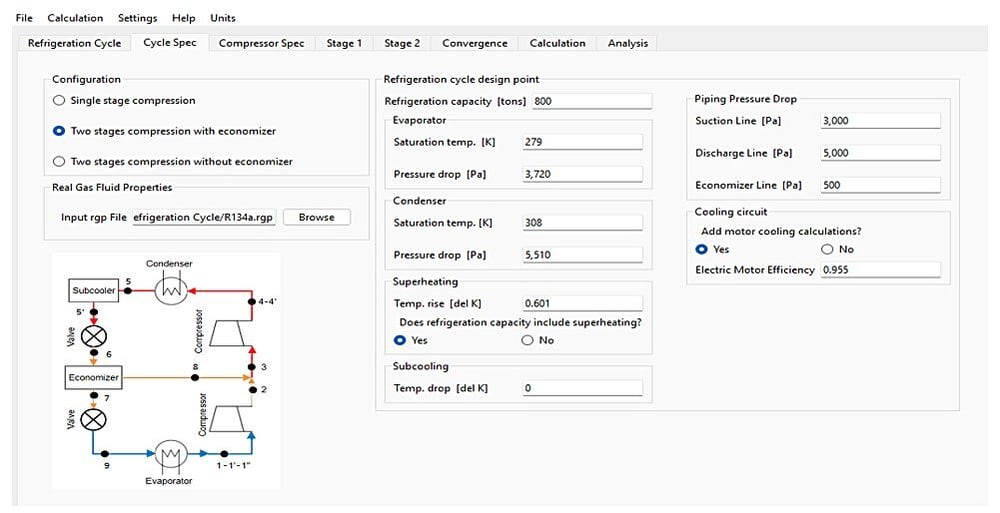
Figure 1: The TURBOdesign Pre interface make setting up refrigeration cycle calculations easy
Complete Refrigeration Cycle Calculations
Unlike fragmented tools that require manual data transfer, TURBOdesign Pre allows for the direct coupling of refrigeration cycle analysis with centrifugal compressor meanline design when calculating the meanline and performance.
-
Integrated Real Gas Properties: TURBOdesign Suite utilizes sophisticated lookup tables (compatible with NIST.rgp formats) to handle real gas properties for a wide range of refrigerants, including R134a, R1234ze(E), and CO2.
-
Instant Refrigeration Cycle Performance Maps: In just a few seconds, the software generates P-H (Pressure-Enthalpy) and T-S (Temperature-Entropy) diagrams. It automatically translates cycle requirements, like cooling capacity and evaporation/condensation temperatures, directly into duty point specifications for your compressor.
-
Automatic Sizing: Once the cycle is defined, the system identifies the required specific speed and provides immediate 1D sizing, ensuring your component is perfectly matched to the system’s needs from the very first step.
-
Single or multi-stage cycles: TURBOdesign Suite understands the different configurations of compressor, sub coolers, economizers within the cycle and instantly computes conditions at every point around the circuit.
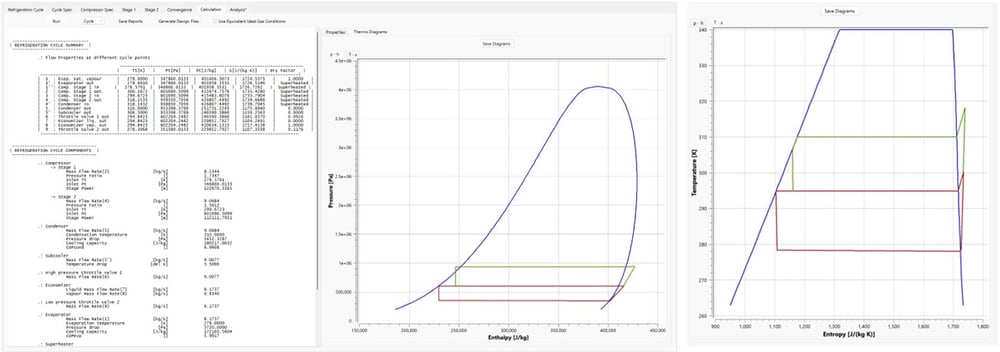
Figure 2: After specification the cycle calculation is completed within seconds. P-h and T-S diagrams for multi-stage cycles are generated from the input data...
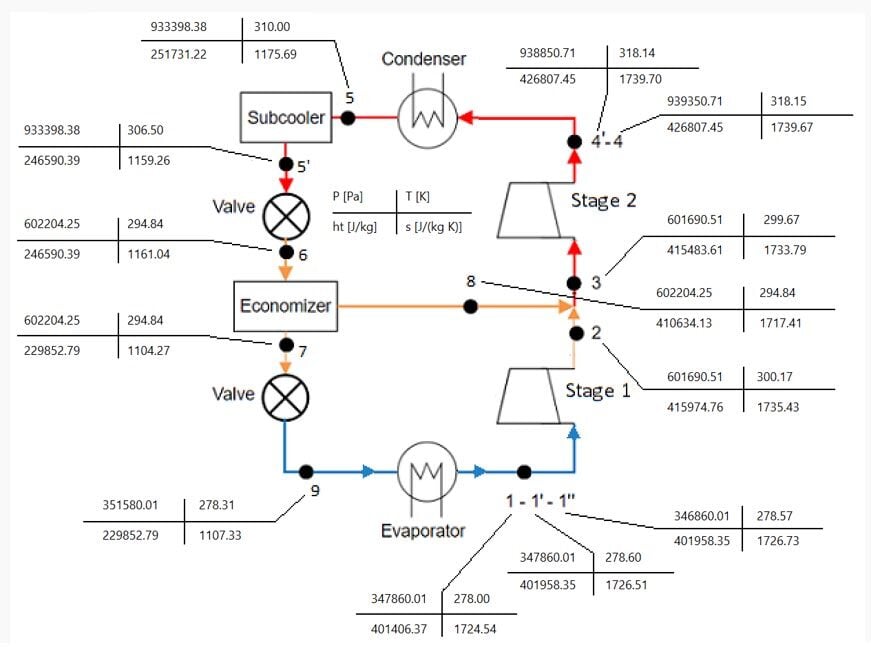
Figure 3: …and the entire cycle diagram is constructed, with temperature, pressure, enthalpy and entropy shown at each point around the cycle
TURBOdesign Pre completes the job by providing the meanline turbomachinery design and performance predictions too. Here you can see the combined and individual performance of each compressor on a predicted map, along with on- and off design performance. This can be sliced in a number of ways, to stay compatible with your own organisations data conventions. For example, Coefficient of Performance versus Refrigeration Capacity:
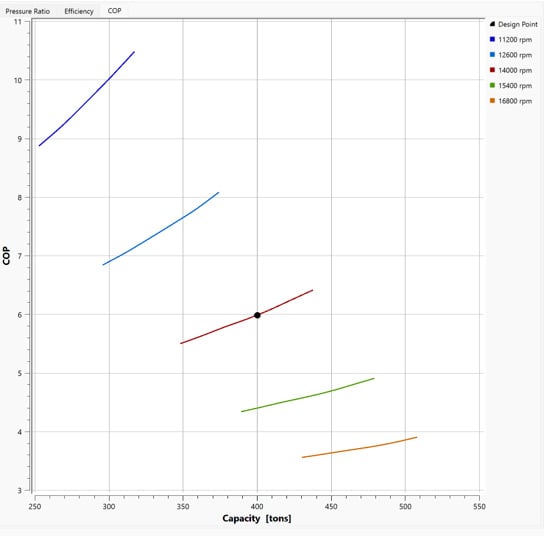
Figure 4: Coefficient of Performance versus Refrigeration Capacity
Or efficiency against mass flow rate, for single or combined stages of turbomachinery:
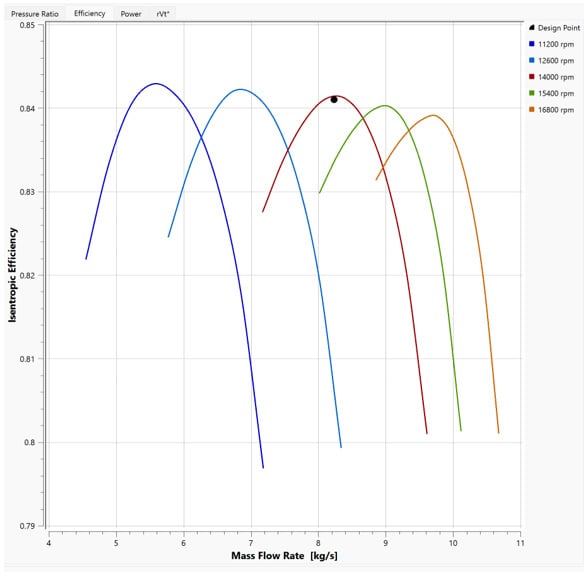
Figure 5: Efficiency against mass flow rate
Along with visualisation of each turbomachinery stage:
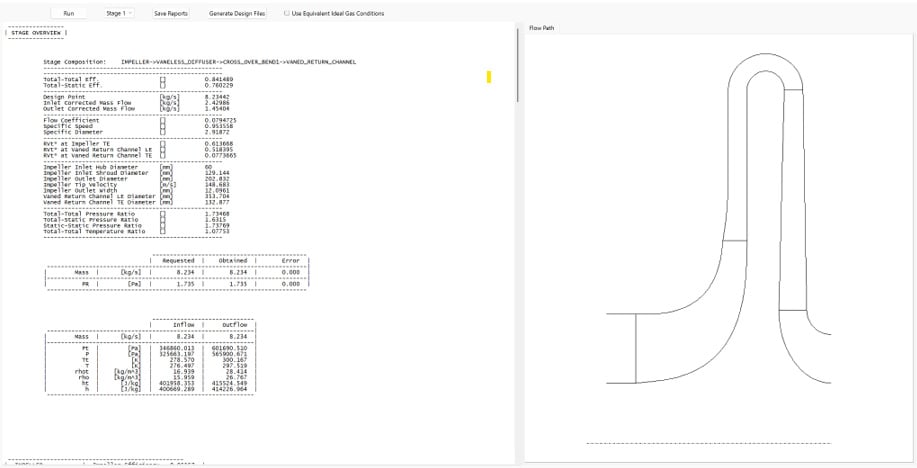
Figure 6: visualisation-turbomachinery-stage
Because the calculation and simulation of the refrigeration cycle is so quick you can very rapidly observe cause and effect relationships at this early stage, and ‘try out’ various combinations of input specifications to find out where you end up on a predicted P-H, T-S and cycle diagrams. This early exploratory work can be more formally and thoroughly exploited by using Machine Learning for refrigeration cycle component design, when you create the full 3D geometries using 3D Inverse Design methods.
3D Inverse Design: Designing by Intent
The unique power of TURBOdesign Suite is 3D Inverse Design. In conventional design, you start with a blade shape and check the flow. In 3D Inverse Design, you start with the optimum flow field (the blade loading) and the software computes the exact 3D geometry required to achieve it.
TURBOdesign Pre has already given you your refrigeration cycle layout, sizing, and performance requirements - now TURBOdesign1 will generate the actual blade shapes to meet those requirements. If TURBOdesign Pre is the refrigeration cycle expert, then TURBOdesign1 is the aerodynamics expert.
This approach allows you to:
- Directly Control Loss Mechanisms: By managing the pressure distribution across the blade, you can suppress secondary flows and tip clearance losses that plague traditional designs.
- Optimize for Real Gas Effects: Since the real gas properties are part of the design process, the 3D blade shape is inherently optimized for the specific thermodynamic behaviour of your refrigerant.
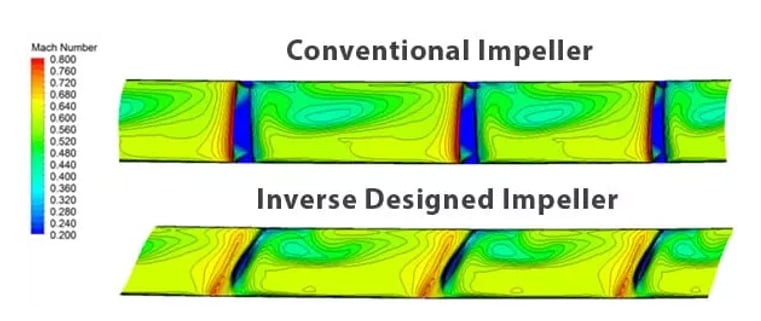
Figure 7: Comparison of Exit Relative Mach Number between the conventional impeller and an Inverse Design impeller showing reduction in exit flow non-uniformity
Full-Cycle Component Control
TURBOdesign Suite provides dedicated capabilities for every component in the refrigeration cycle:
-
Impellers & Inducers: Design high-efficiency centrifugal impellers with precise control over streamwise and spanwise loading. This is critical for maintaining performance across a wide operating map.
-
Vaned & Vaneless Diffusers: Utilize 3D Inverse Design to eliminate corner separations in vaned diffusers, a common cause of efficiency drops in multi-stage applications.
-
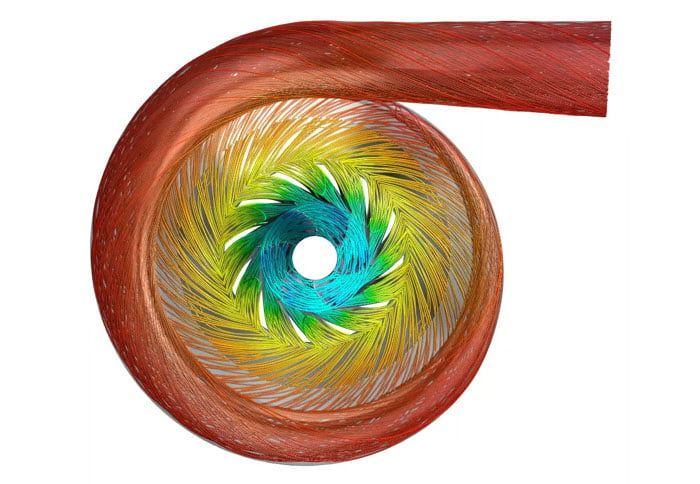
Advanced Volute/Scroll Modelling: The software enables the creation of complex 3D volutes with non-circumferentially uniform inlet velocities, ensuring the flow exiting the impeller is managed with minimal energy loss.
-
Return Channels: For multi-stage chiller compressors, TURBOdesign Suite automates the design of return channels to ensure the flow enters the subsequent stage with the correct swirl and velocity profile.
Machine Learning for Design Optimization
TURBOdesign Suite employs a Reactive Response Surface (RRS) Machine Learning algorithm to intelligently evaluate a complete design space in a fraction of the time it would take in high-fidelity CFD.
By using just a handful of parameters (3D Inverse Design requires only a small number of controls to fully describe the 3D blade shape), you can set objectives, like maximizing efficiency at both design and off-design points and let the software find the multi-point, multi-objective performance optimum. We have many examples of companies achieving significant performance gains with 3D blade designs that are otherwise unachievable with conventional methods, and all in vastly reduced timescales.
Conclusion - World Leading Refrigeration Cycle Design
TURBOdesign Suite doesn't just help you design a component; it helps you understand and control the physics of your entire refrigeration system. From the initial cycle calculation to the final watertight 3D CAD model of a volute, every step is connected, automated, and optimized.
Key Advantages at a Glance:
- Speed: Reduce design time compared to conventional methods.
- Intelligence: Achieve paradigm breaking performance gains by directly controlling aerodynamic behaviour
- Versatility: Handle any refrigerant, from traditional HFCs to low-GWP and natural refrigerants like R1234ze or Ammonia.
Book a LIVE demo on the design of a turbomachinery application of your choice.
Our demo is tailored to your specific application and design challenges



Share This Post