
A new approach to optimizing a hydrodynamic design of pump diffuser is presented, based on a three-dimensional inverse design method and a Computational Fluid Dynamics (CFD) technique. The blade shape of the diffuser was designed for a specified distribution of circulation and a given meridional geometry at a low specific speed of 0.109 (non-dimensional) or 280 (m3 /min, m, rpm).
To optimize the three-dimensional pressure fields and the secondary flow behaviour inside the flow passage, the diffuser blade was more fore-loaded at the hub side as compared with the casing side. Numerical calculations, using a stage version of Dawes three-dimensional Navier-Stokes code, showed that such a loading distribution can suppress flow separation at the corner region between the hub and the blade suction surface, which was commonly observed with conventional designs having a compact bowl size (small outer diameter).
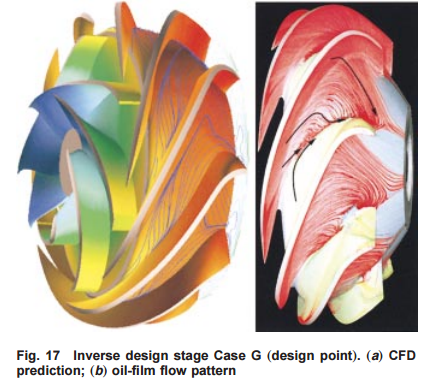
The improvements in stage efficiency were confirmed experimentally over the corresponding conventional pump stage. The application of multi-color oil-film flow visualization confirmed that the large area of the corner separation was completely eliminated in the inverse design diffuser.
Read the publication in full
Book a LIVE demo on the design of a turbomachinery application of your choice.
Our demo is tailored to your specific application and design challenges


Share This Post